By Owen Blot · Founder, Maynox · Last updated May 31, 2026
- What a dad bod actually is — and the visual signature most articles miss
- The three real causes nobody's lying about
- The ROI hierarchy: what to fix, in what order
- Week 1: the posture & presence reset (visible the same week)
- Months 1–3: the real body work
- What doesn't work (and why TRT isn't the shortcut)
- The compression base layer: your same-day visual lever
- FAQ
Your reflection in the bathroom mirror has changed. Not dramatically — just enough that you noticed it this year. The shirt fits differently. The belt sits in a new spot. Your jawline has more shadow under it than it used to. The internet has a name for this and you already know what it is.
What the internet doesn't tell you is that the dad bod isn't really a fat problem. It's a sequence problem — guys try to fix all of it at once, burn out in two weeks, and conclude the dad bod is permanent. It's not. Here's the honest plan.
What a dad bod actually is — and the visual signature most articles miss
The medical definition is boring: a soft midsection, declining muscle mass, and more fat around the belly than you used to carry. True. But that's not what people actually see when they look at you.
The dad bod has a specific visual signature, and most articles skip it: it's not just the belly. It's a combination. Soft pecs that have lost their square. Shoulders that round forward. A neck that's drifted in front of your chest. A waist that's wider than your shoulders read. Your belly looks bigger than it is because everything around it has gotten softer and rounder too.
That's why two men with the same waist measurement can look completely different. One stands tall, has a square chest, shoulders pulled back — he reads "in shape, a little extra." The other rounds forward and reads "dad bod."
This matters because it tells you where the fastest wins are.
The three real causes nobody's lying about
Skip the listicle "10 causes of dad bod" articles. There are three real ones, and they stack on top of each other.
1. You're not moving like you used to. Not the cardio you skipped — the background movement. Walking around campus, lifting boxes, playing pickup basketball, standing at concerts. Sit-down job, sit-down commute, sit-down evening, repeat for fifteen years. Your largest muscle groups (legs, glutes, back) are getting less stimulus than they did at 25, and they shrink. The NIH puts the muscle loss rate at 3–8% per decade after age 30 if you don't lift against meaningful resistance.1
2. Your testosterone has drifted down, and partnering accelerated it. This is the part the NASM-credentialed crowd actually got right. The Mayo Clinic puts the natural drop at about 1% per year after age 30.2 Then there's the partnering effect: a published study tracking US fathers found that men in partnered, caregiving relationships had measurably lower testosterone than single non-fathers — your body biologically downshifts when you're invested in family.3 That's not a character flaw. It's biology selecting for empathy and patience over status competition. The cost is fat that parks itself around your midsection.
3. You're under-recovered. CDC data shows 30.5% of US adults get less than 7 hours of sleep.4 Sleep deprivation tanks testosterone further, spikes cortisol, kills protein synthesis, and makes you crave the foods that make this worse. Stress from work and kids does the same thing. The dad bod is, in large part, a chronic-recovery debt showing up on your stomach.
Three causes. Movement deficit. Hormonal drift. Recovery debt. Everything else (alcohol, ultra-processed snacks, sitting at sports practice) is downstream of these.
The ROI hierarchy: what to fix, in what order
Here's where every other dad bod article fails you: they hand you a single 40-item to-do list. Do strength. Do cardio. Sleep more. Reduce stress. Eat protein. Cut sugar. Hydrate. Track macros. Take adaptogens. You read it, feel overwhelmed, and quit.
The real plan is ordered by how fast you'll see results and how cheap the action is:
| Tier | Time horizon | What you fix | Why it matters |
|---|---|---|---|
| 1 | This week | Posture, breathing, base-layer fit | Visible same day. Free or near-free. |
| 2 | Months 1–3 | Strength training + protein + sleep | Real body composition change. |
| 3 | Months 3–6 | Body fat trim + nutrition refinement | Visible belly reduction. |
| 4 | Months 6+ | Hormonal / metabolic optimization | Only if Tiers 1–3 stall. Talk to a real doctor. |
Most guys try to start at Tier 3 or 4. That's why they fail. Start at Tier 1. It gives you a quick visible win, which buys the patience you'll need for Tier 2 to compound.
If you want the underlying biology of why this sequence works, we wrote it up in how a man's body changes after 40. And if your belly specifically is the part you're trying to attack first, why men get a belly after 40 covers that in depth.
Week 1: the posture & presence reset (visible the same week)
This is the part the dad bod listicles never tell you: most of what makes a dad bod look like a dad bod is how you carry yourself, not how much fat you carry. Fix the carrying first.
Stand against a wall, three times a day, for 30 seconds. Heels, butt, upper back, and the back of your head all touching. Hold. Walk away keeping that feeling. That's it. The NIH estimates more than 80% of Americans will deal with significant posture issues at some point5 — meaning your competition is also slouching. Standing tall makes you read leaner before you've lost a pound.
Set your screens to eye level. The Cleveland Clinic notes the head weighs 10–12 lbs in neutral position, 27 lbs when tilted 15° forward, and up to 60 lbs at chin-to-chest.6 Your daily phone scroll is pulling your head, neck, and chest forward — which softens the look of your pecs and rolls your shoulders in. Lift your phone. Raise your monitor. Same-week impact.
One walk after dinner. 15–20 minutes. Not for calories. For posture, digestion, and to interrupt the sit-eat-sit cycle that's calcifying through your evening.
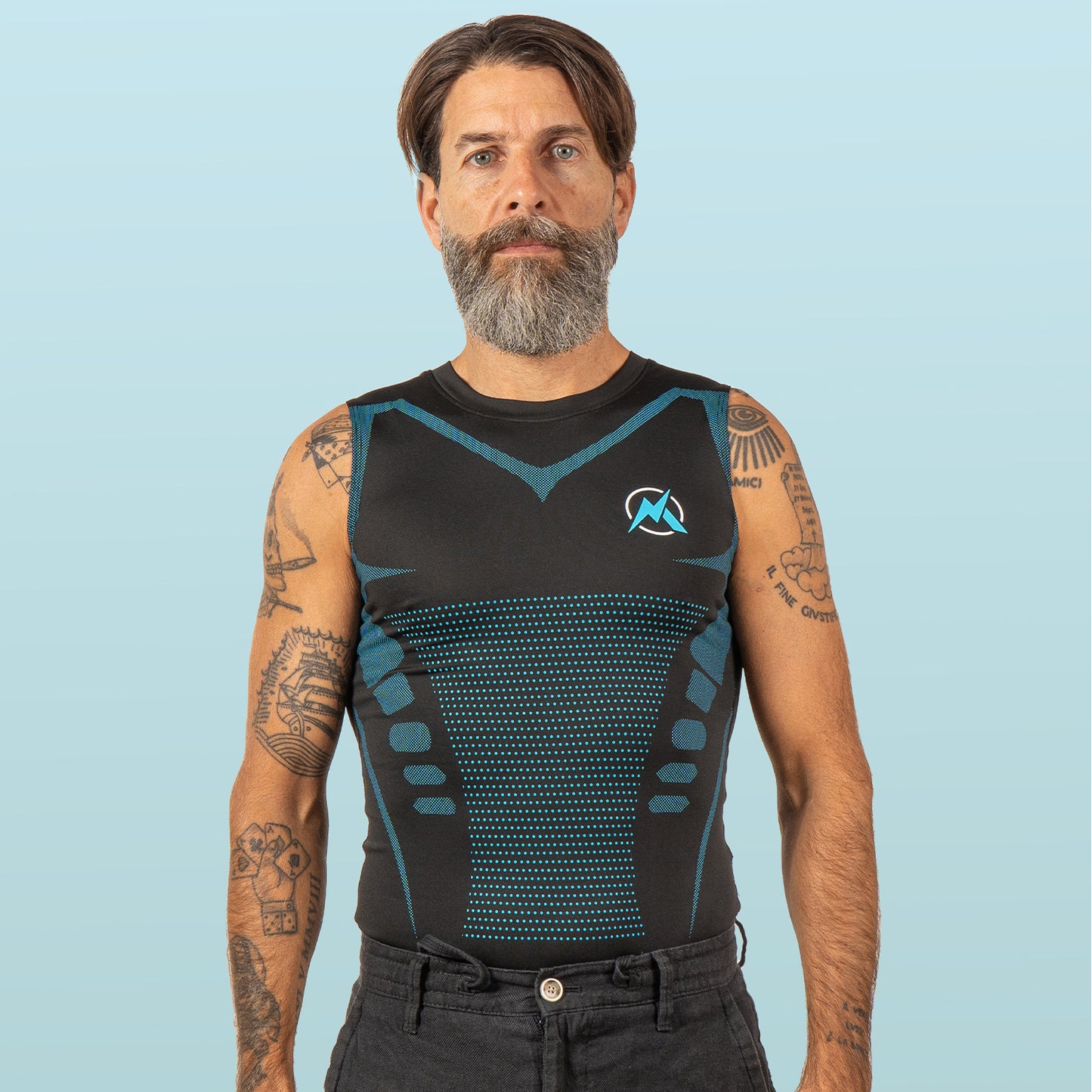
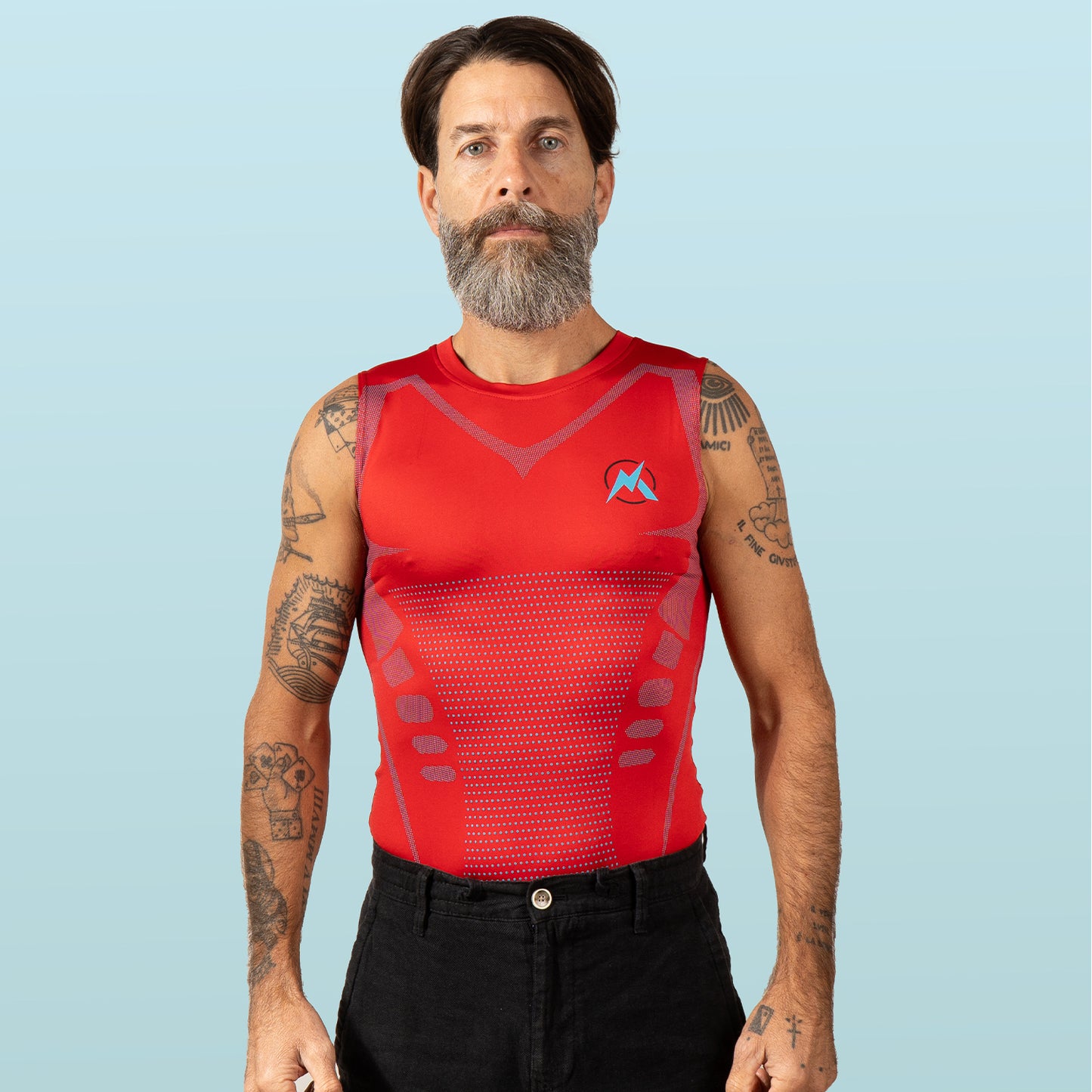
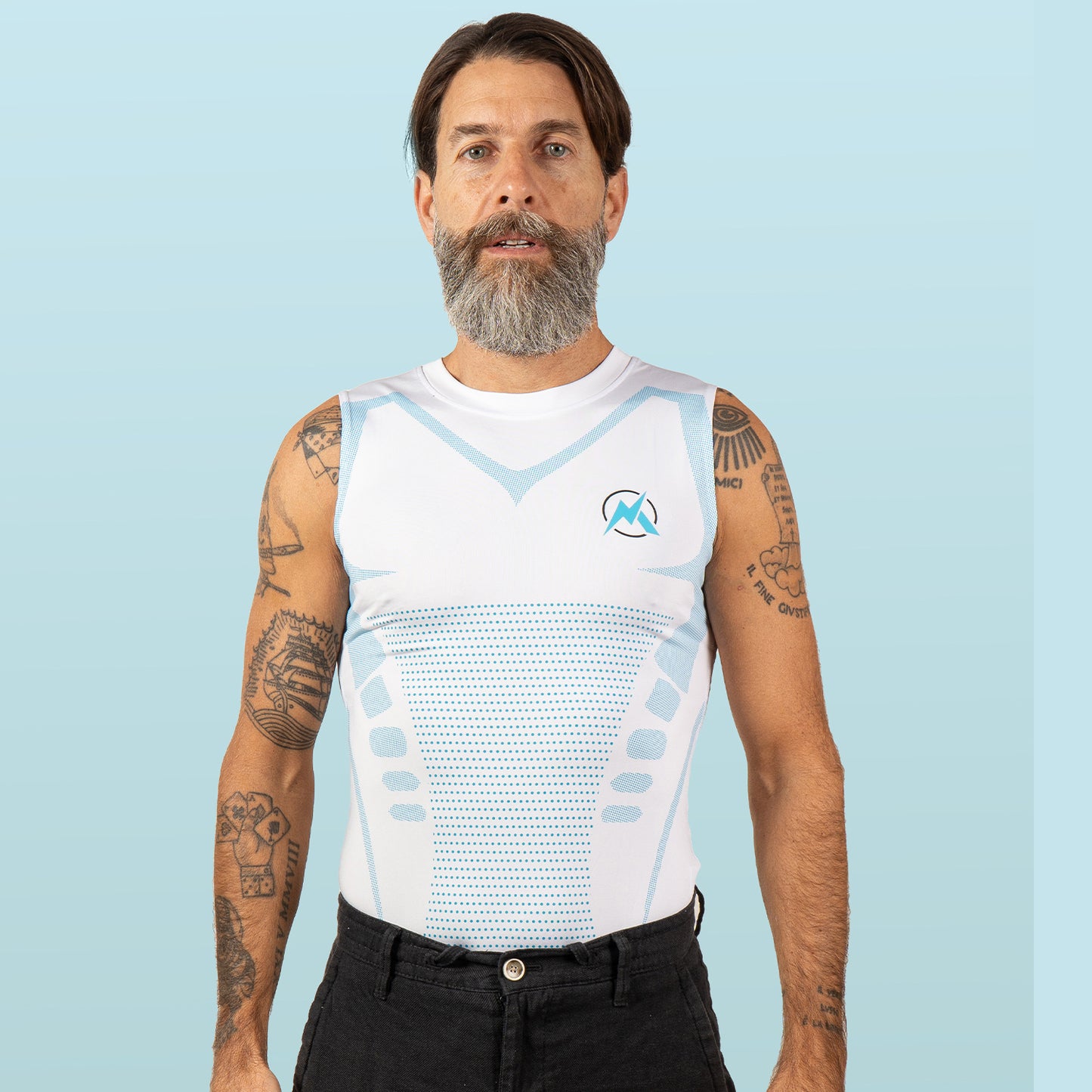
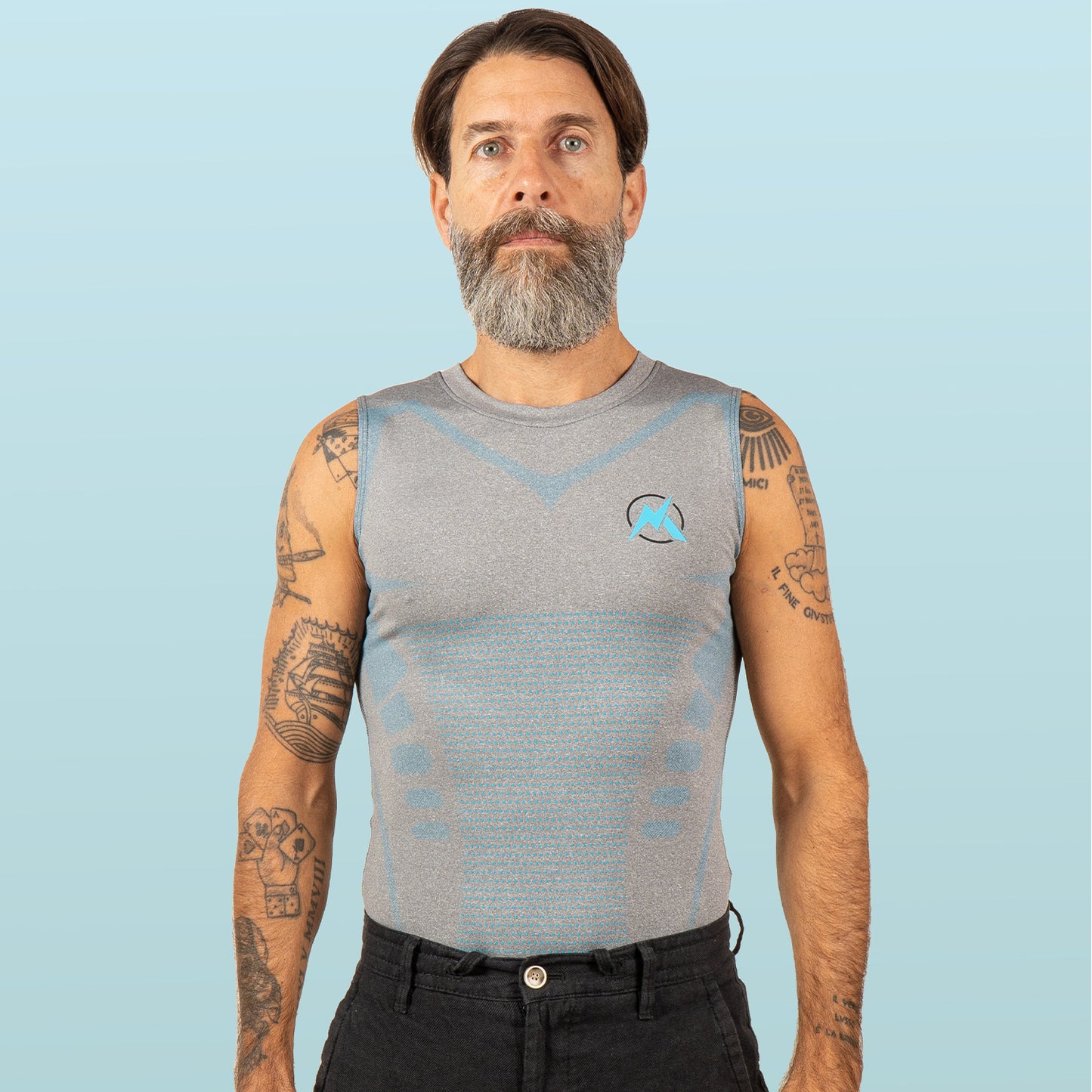
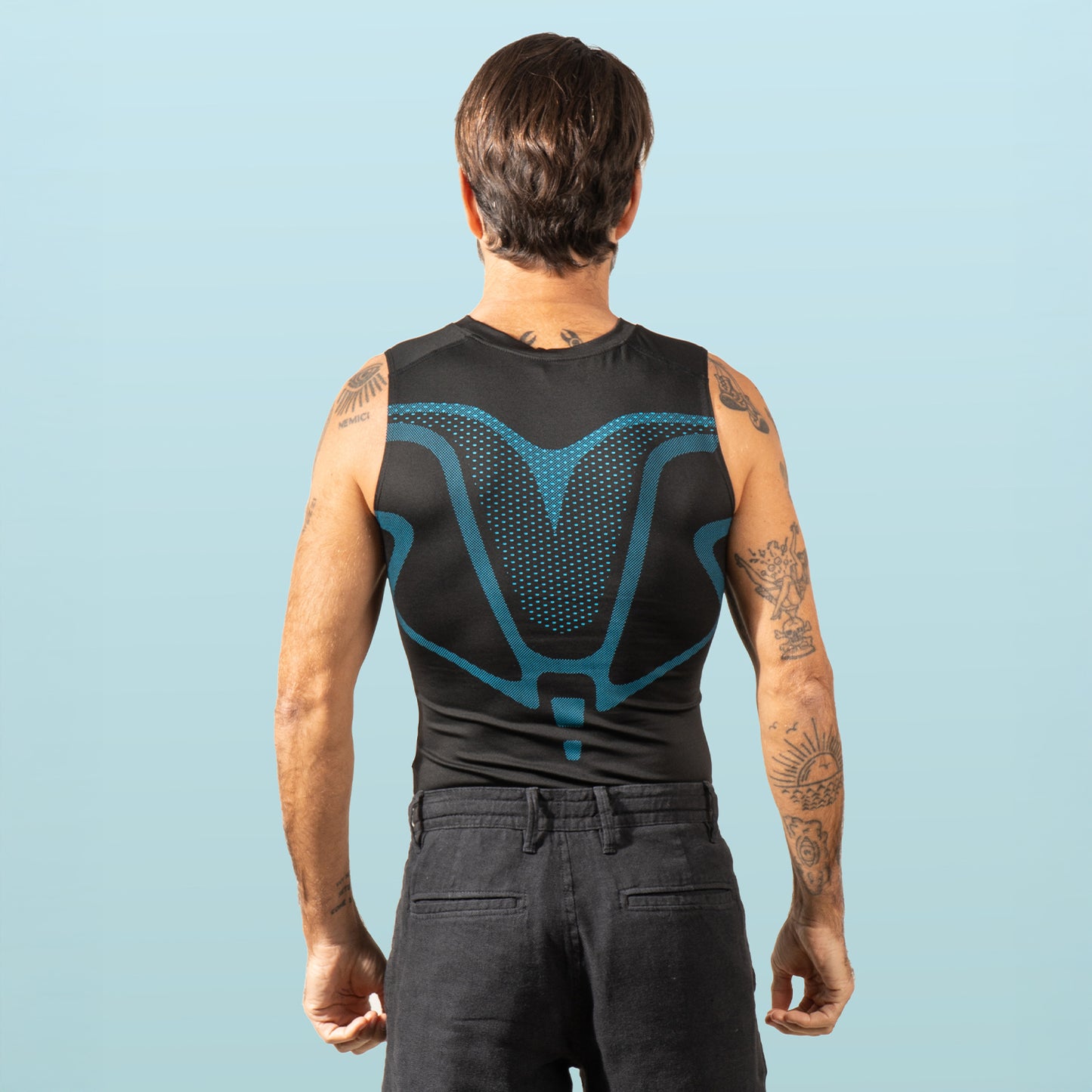
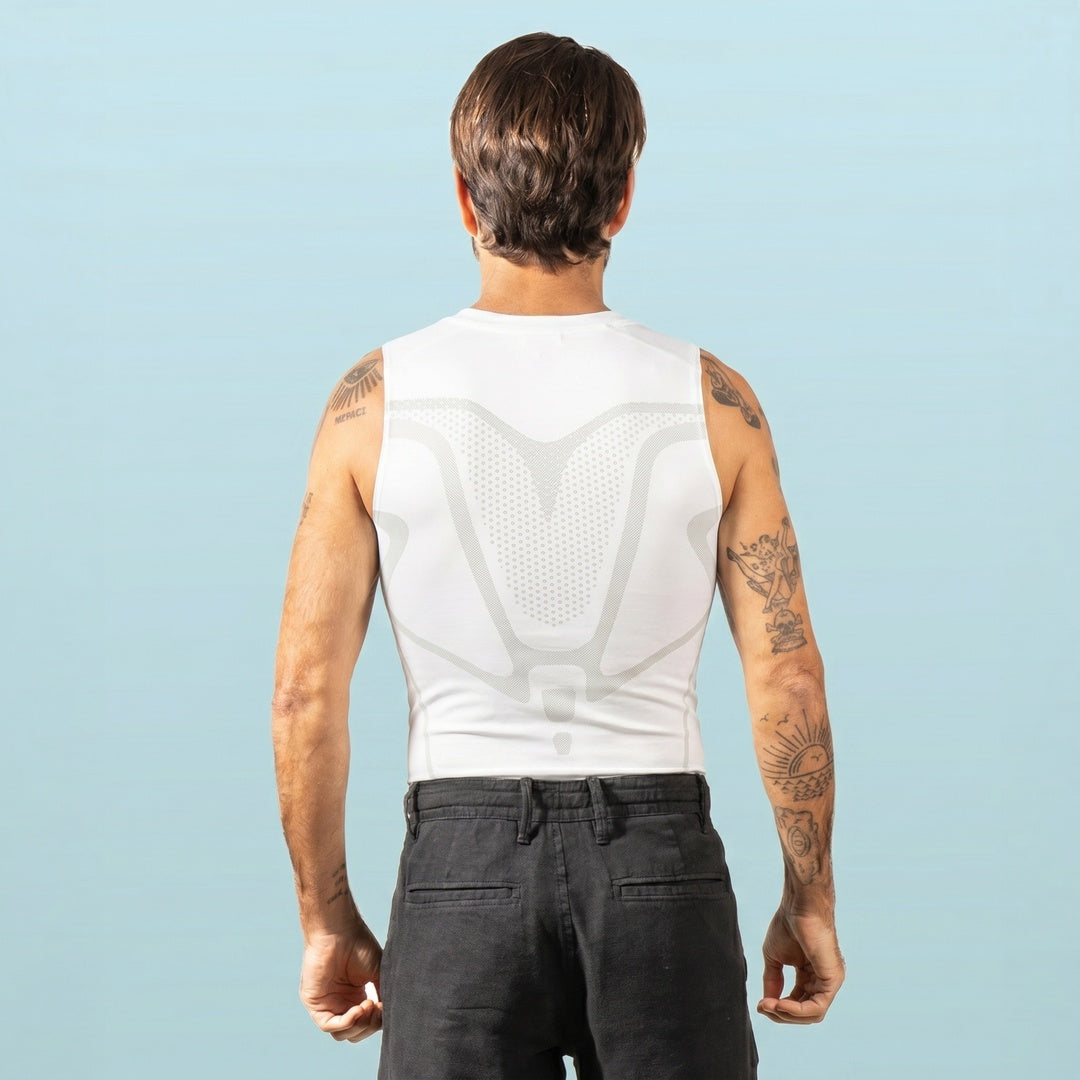
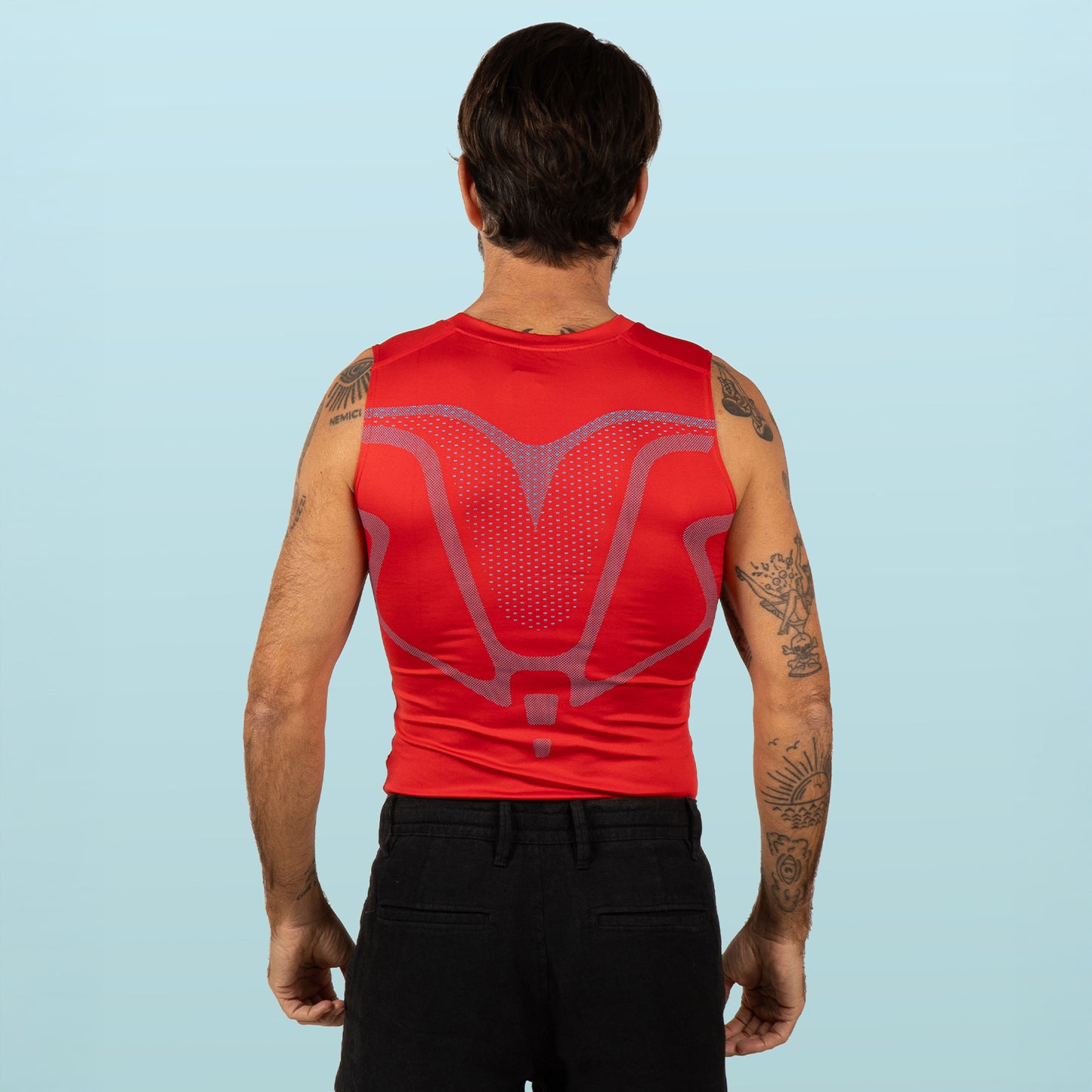
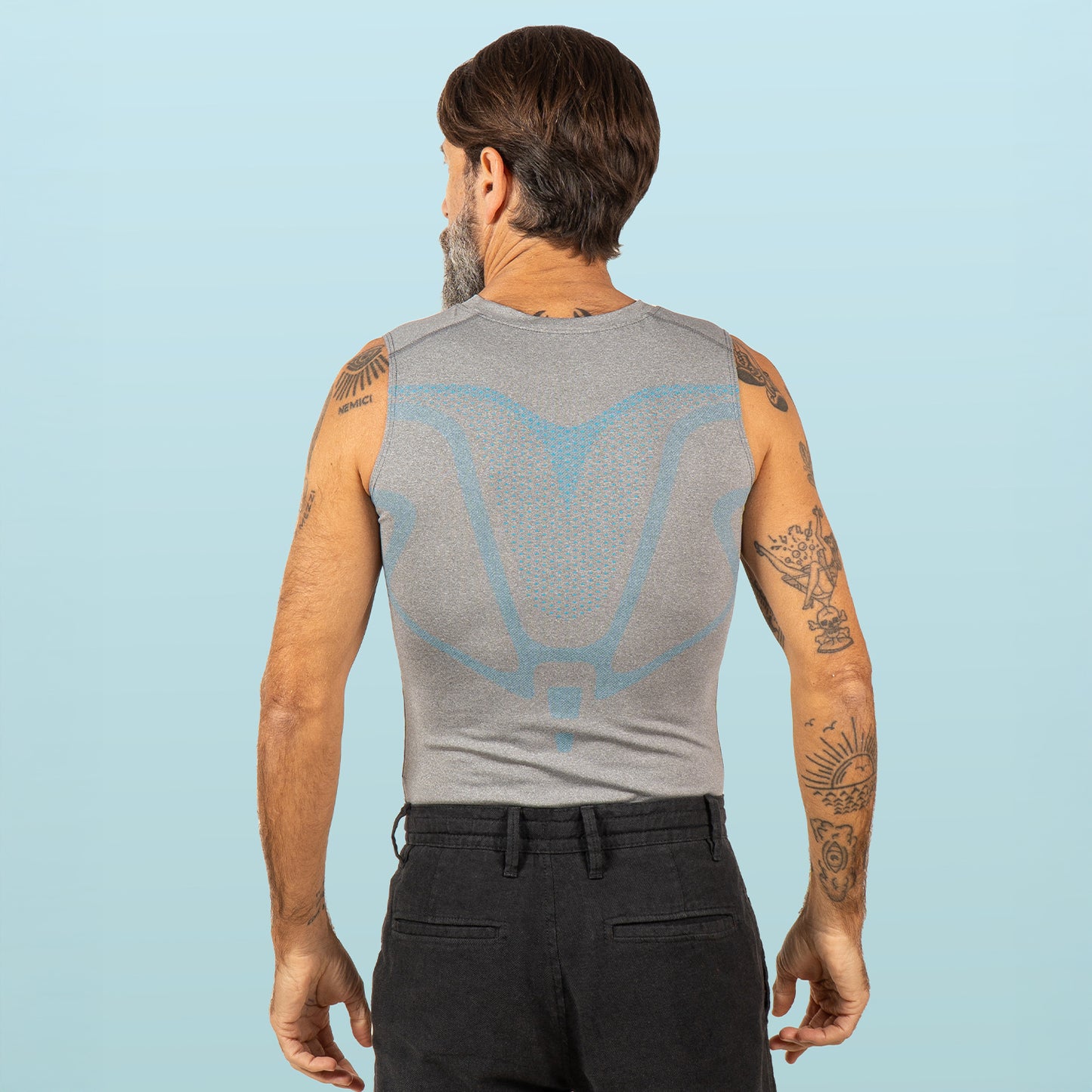
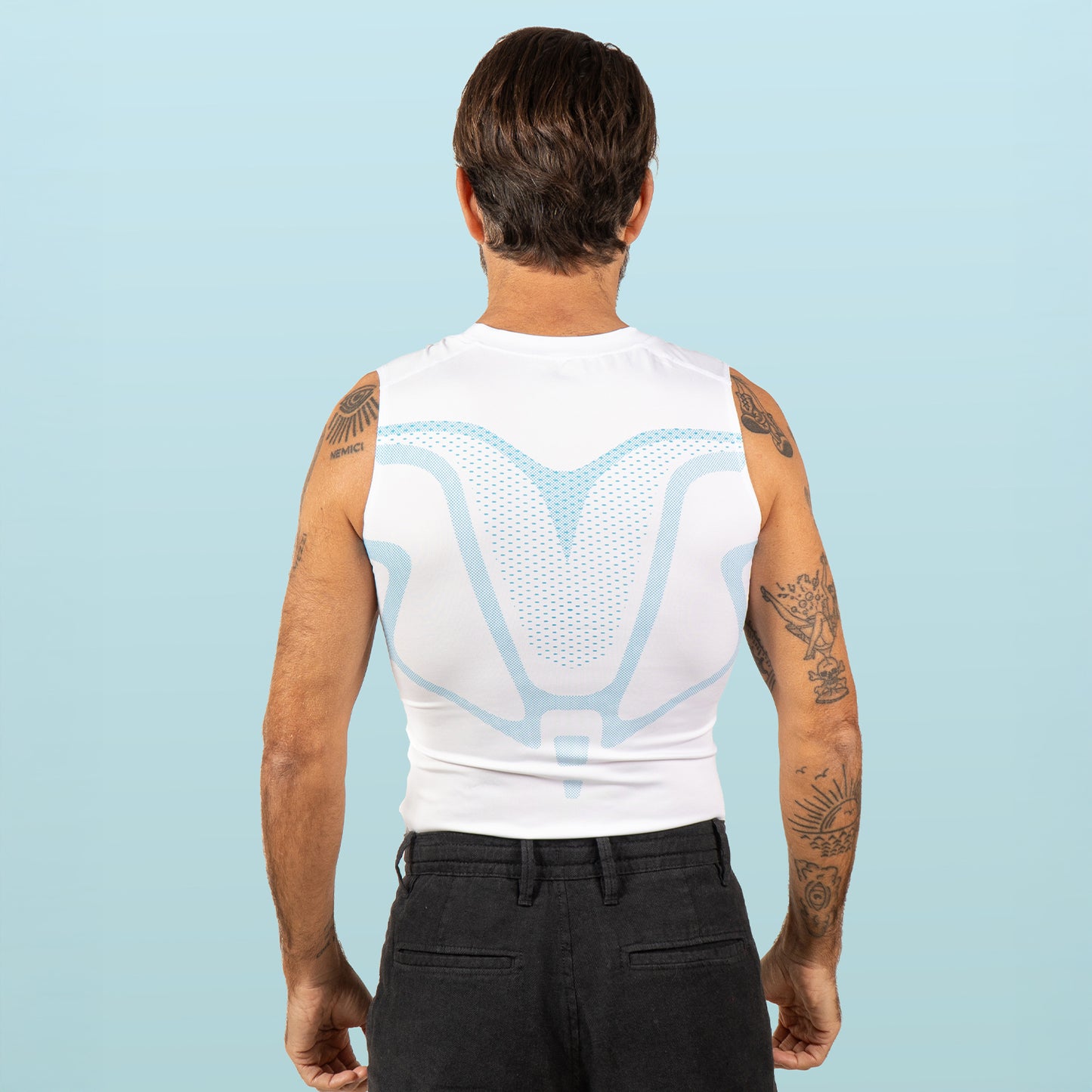
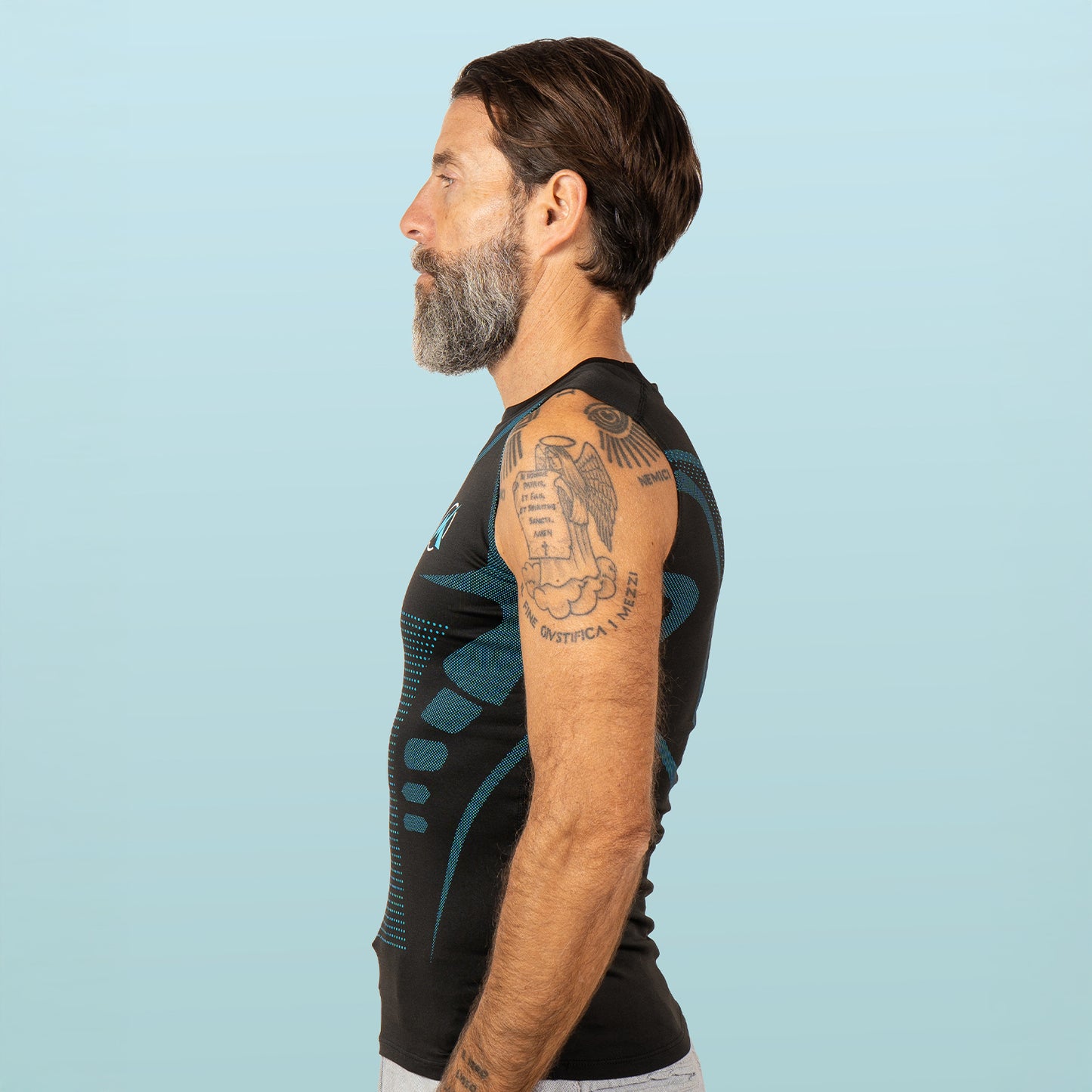
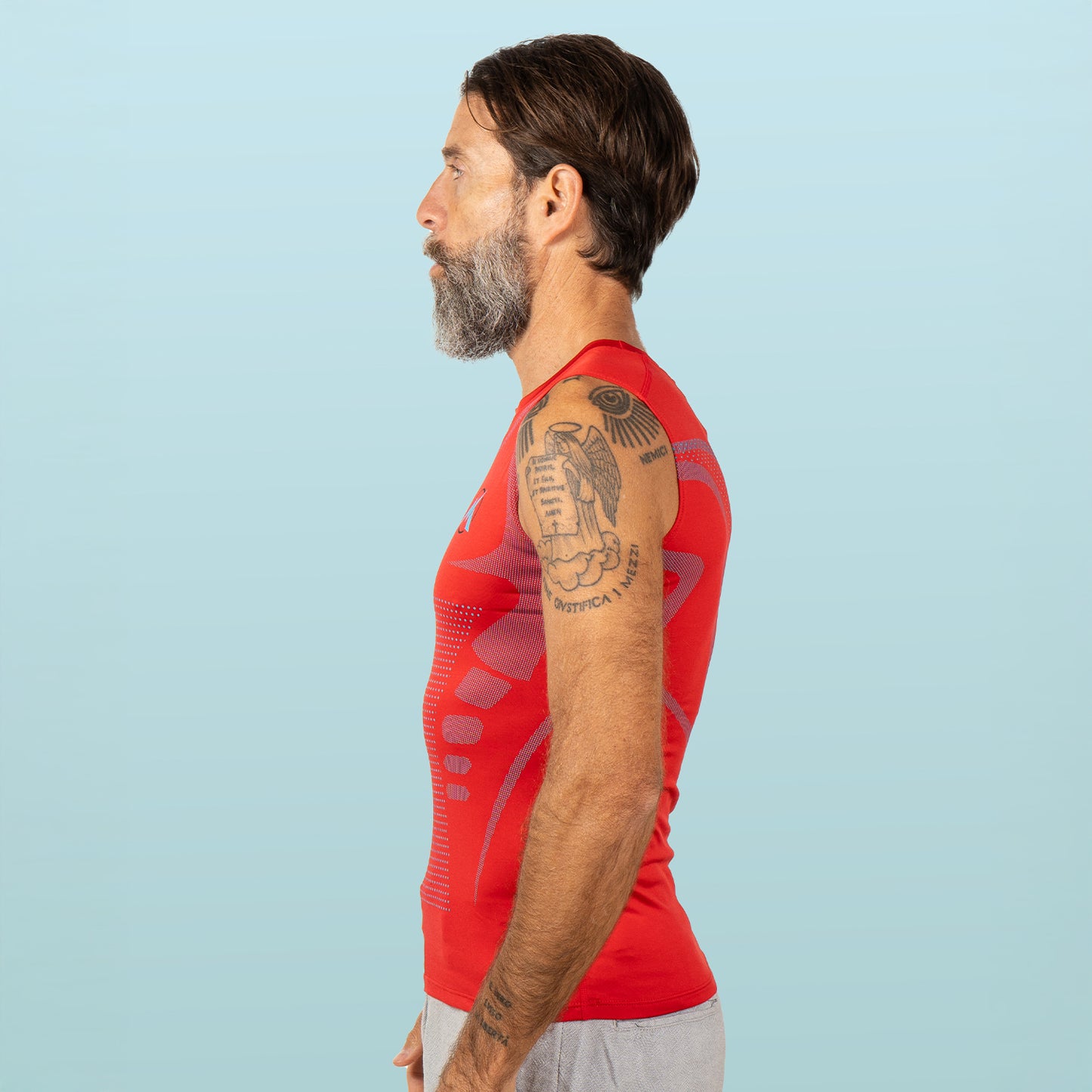
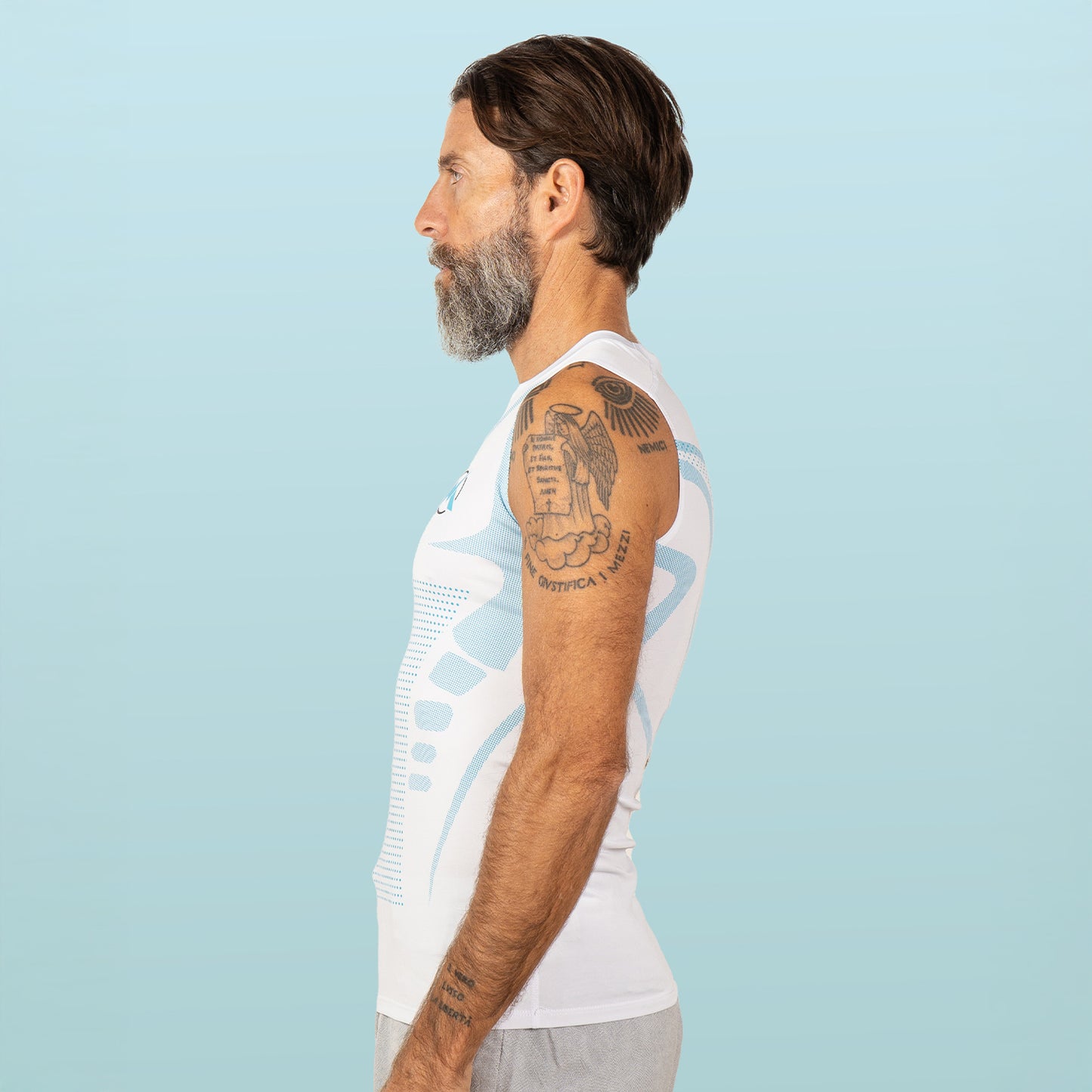
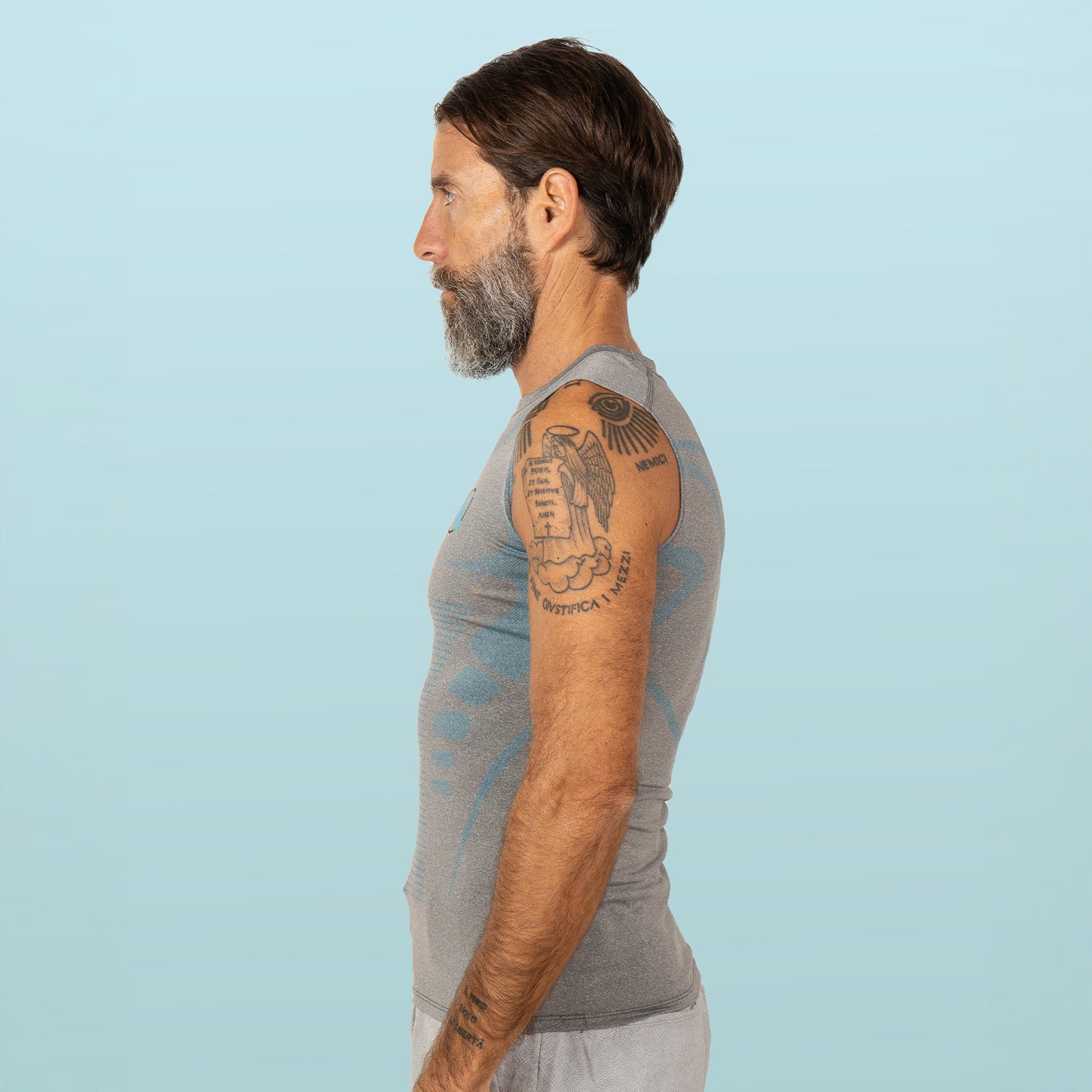
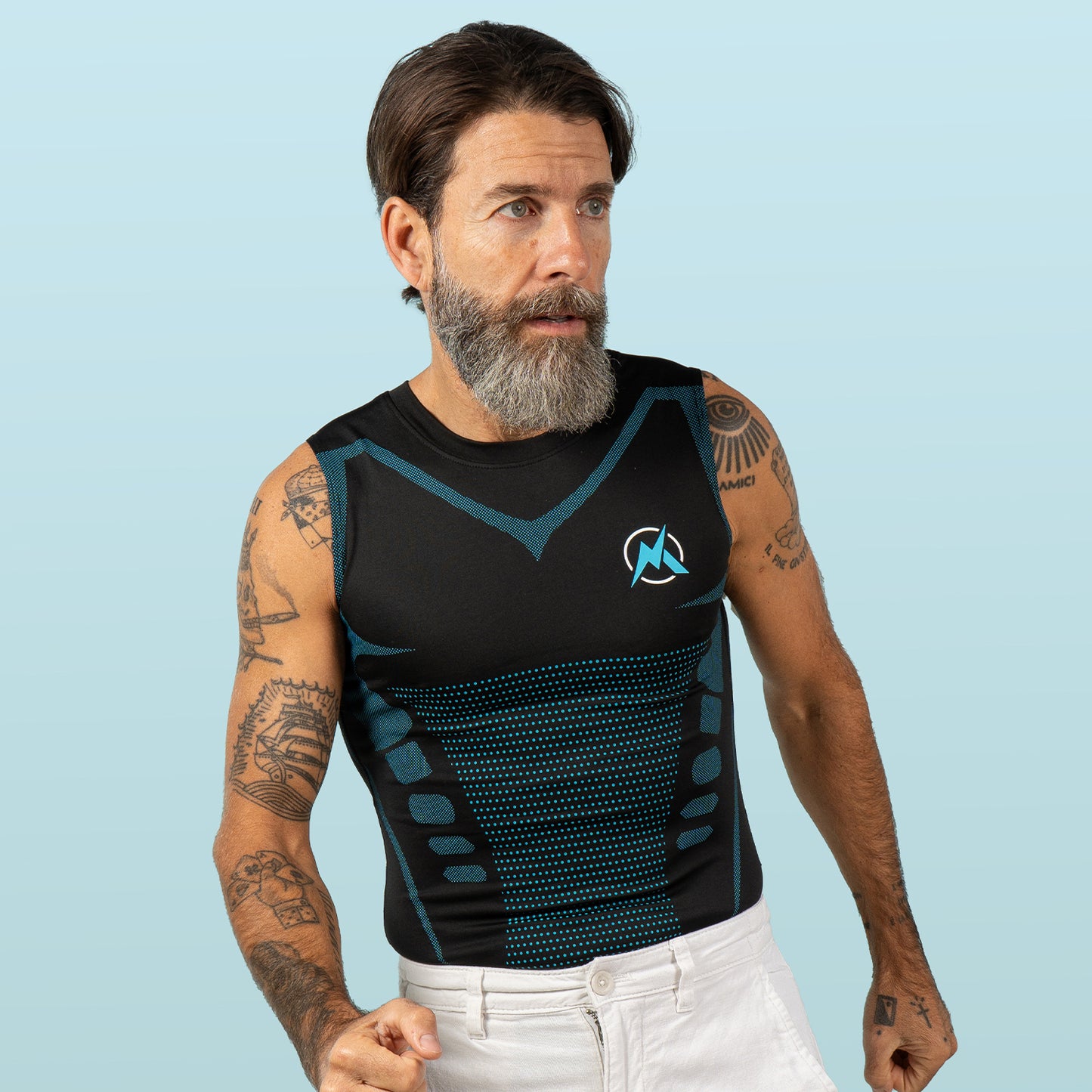
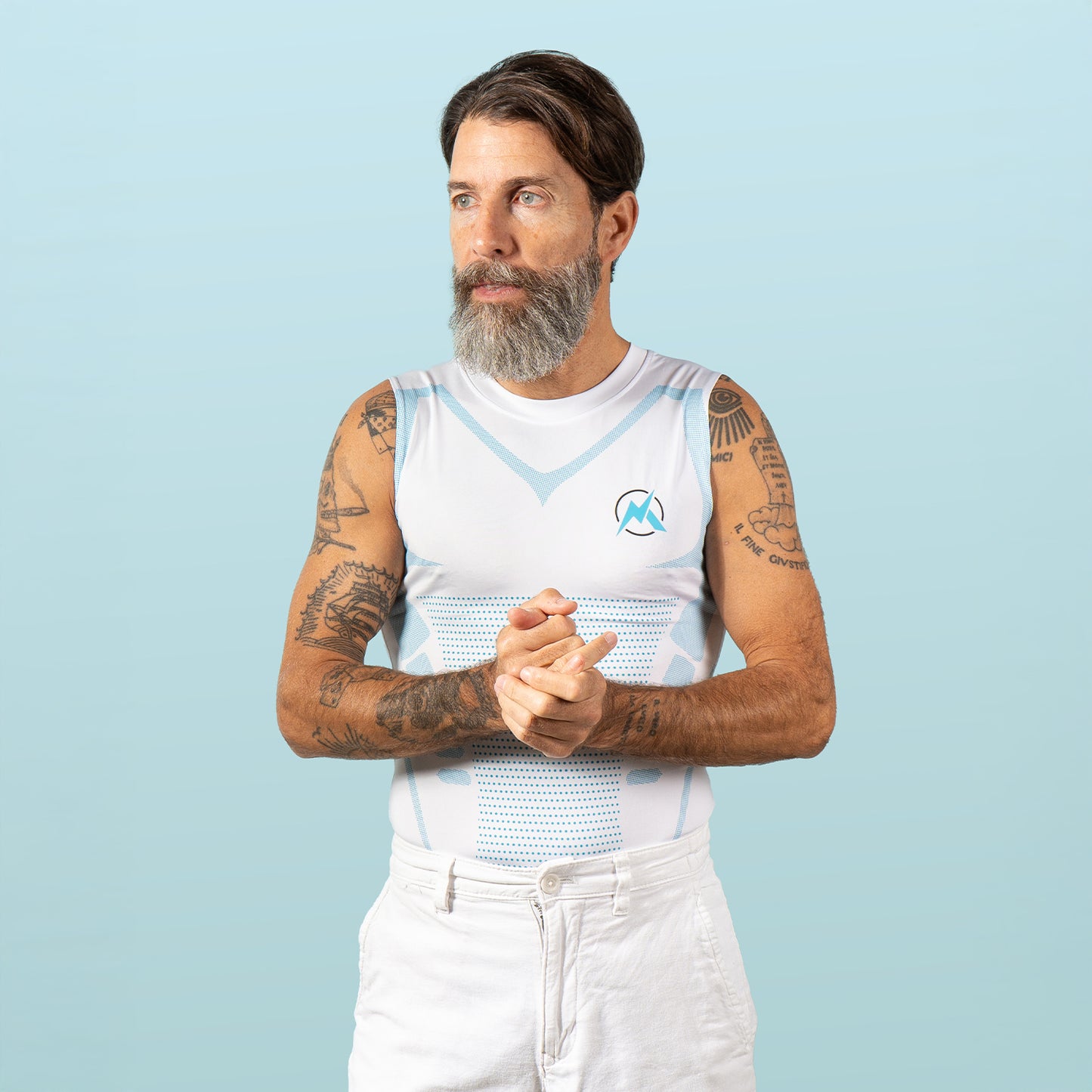
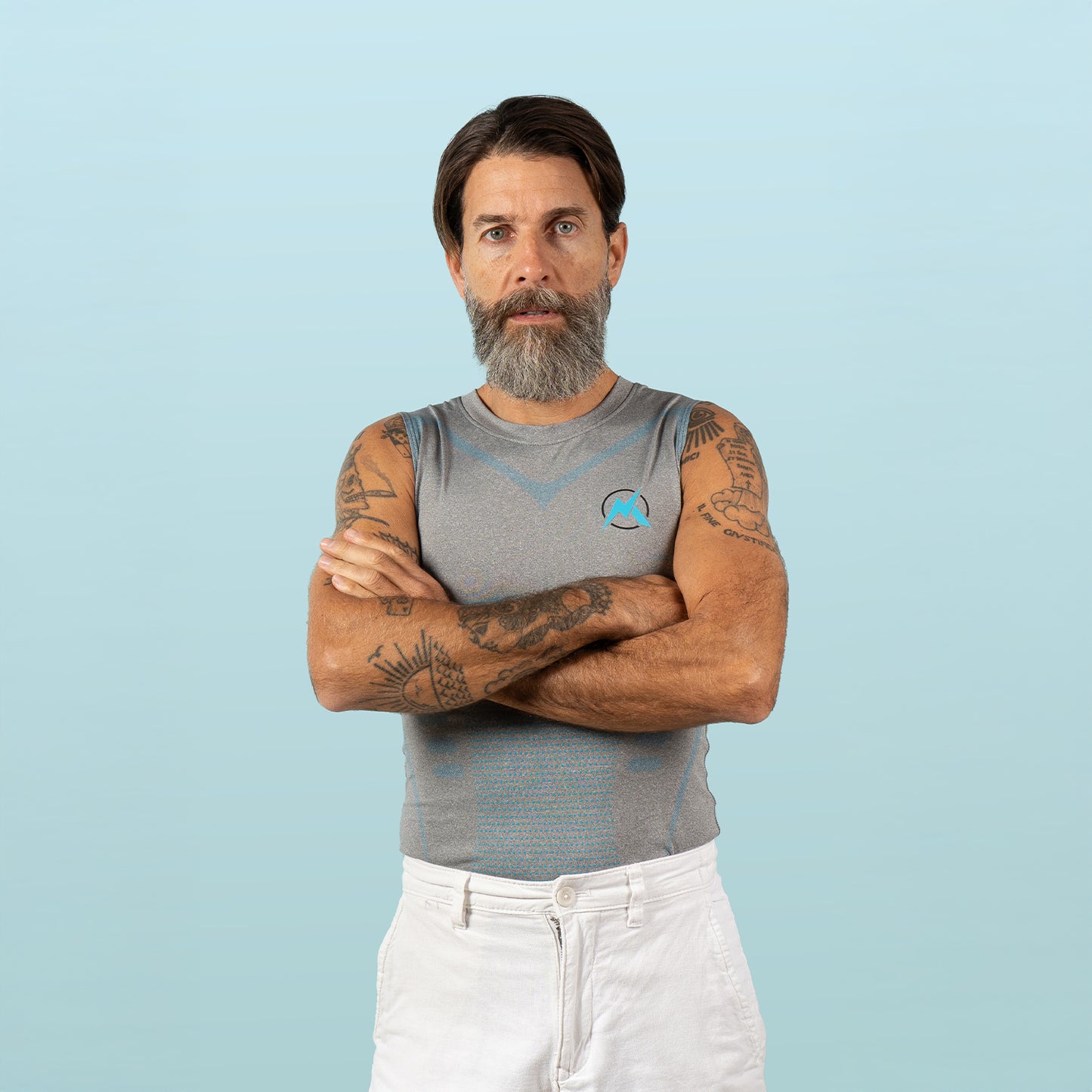
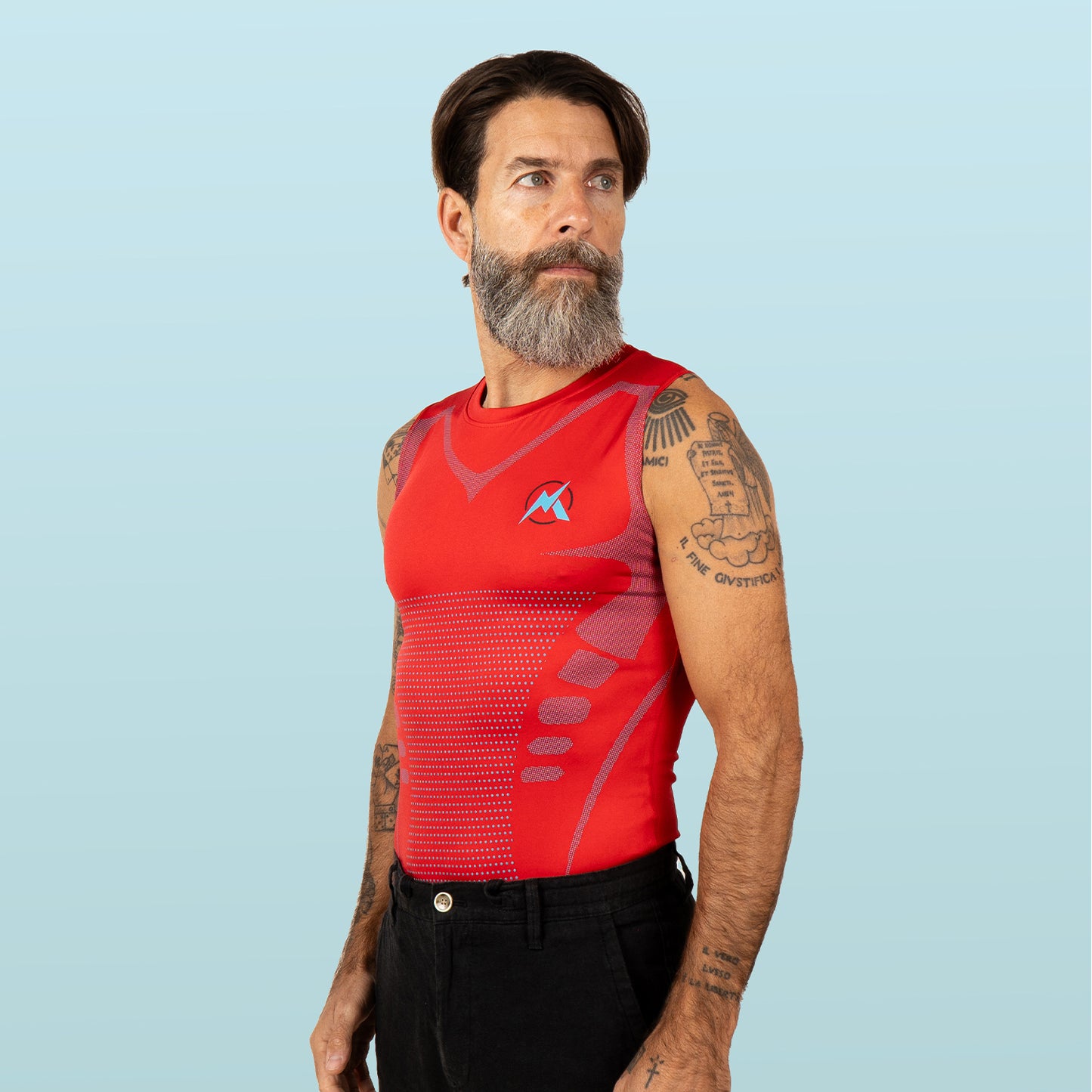
Layer a compression base under your shirt. This is the same-day visual lever. A real compression tank under a normal t-shirt or button-down does two things: it gives proprioceptive feedback (your nervous system reminds itself to pull your shoulders back) and it smooths the soft-pec-soft-belly silhouette that makes the dad bod read at a glance. Brown et al. 2022 in Sports Medicine reviewed the compression-garment literature and found proprioceptive feedback + reduced perceived soreness as the consistent benefit across studies.7 It's not magic. It's a daily-wear assist while the rest of the work compounds.
End of week 1 you should look noticeably more squared-up in the mirror. Same body. Different carrying. That's the win that buys you the patience for the slower work.
Months 1–3: the real body work
Tier 1 made you look better. Tier 2 makes you be better. Three pillars, nothing exotic.
Pillar 1 — Strength, three times a week, compound lifts. This is non-negotiable. Cardio alone won't reverse a dad bod, because cardio doesn't build the muscle that gives you a square chest, shoulders, and a tighter midsection silhouette. Harvard Health analyzed 10,500 men and found that those doing 20 minutes/day of weight training had less age-related abdominal fat than those doing equivalent cardio time.8 The pattern that works for 40+: squat, deadlift, press, row, pull. Three sessions a week. 45 minutes each. That's it. Add isolation work later if you want to.
Pillar 2 — Protein you can actually hit. The research-backed window for fat-loss-while-keeping-muscle is 1.6–2.2 g/kg of body weight per day (roughly 0.7–1.0 g/lb). For a 200 lb man that's 140–200 g/day. That sounds like a lot until you split it: 40g at breakfast, 40g at lunch, 40g at dinner, 30g across snacks. Yogurt, eggs, lean meat, fish, a protein shake when life gets in the way. You don't need to track macros for years. You need to hit a protein floor every day.
Pillar 3 — Sleep before optimization. You can't out-train sleep debt. 7+ hours, dark room, phone out of the bedroom, last meal not at 10pm. The CDC's 30.5% sub-7-hour stat4 is the population baseline you're competing against. Fix this and your body composition starts cooperating instead of fighting you.
Three pillars. Done in the same evening. Total time commitment: ~4 hours of training a week and not eating like a college kid. That's the real plan.
Where to slot in the work: the stand-up-straight habit stack shows you how to anchor the posture and walk work to existing routines so it sticks. And if you want the morning version of the energy work that makes any of this actually possible, why you feel tired all the time after 45 covers the sleep/recovery hierarchy.
What doesn't work (and why TRT isn't the shortcut)
Half the dad-bod content on the internet sells you a shortcut. Most of them don't deliver.
TRT (testosterone replacement therapy) is not a first-line answer. It can be appropriate if you have clinically diagnosed low testosterone and a real medical workup, but the dad-bod TRT clinics that test you, declare you "low," and start you on a lifetime medication are selling a recurring subscription, not a fix. The Mayo Clinic explicitly cautions that testosterone therapy comes with risks (cardiovascular concerns, sleep apnea, fertility changes) and that the "andropause" framing is "scientifically inaccurate" for most men.2 Fix sleep, strength, and stress first. Then test. Then talk to an actual endocrinologist, not a clinic that advertises on Instagram.
- Spot-reduction is a myth. No amount of crunches will make abdominal fat go first. Your body decides the order. Sorry.
- Detox teas, "metabolism boosters," T-booster pills. The consistent finding from independent reviews is minimal-to-no clinical effect beyond what good sleep, lifting, and Vitamin D would do for free.
- 30-day transformations. The math doesn't work. A safe fat loss rate is ~1–2 lbs/week. If you have 20+ lbs to lose, you're looking at 3–6 months minimum to a visibly different body.
- Cardio alone. Useful for heart health. Insufficient for dad bod reversal. You need to build muscle, not just burn calories.
The honest version: three months of consistent Tier 2 work outperforms any shortcut. Twelve months of it gives you a body you'll keep.
The compression base layer: your same-day visual lever
We mentioned compression in Week 1 because it's the cheapest, fastest visual lever you have. Here's the longer version.
A purpose-built men's compression tank does three things while the deeper work compounds:
It smooths the visible silhouette under shirts. The soft-pec/soft-belly contour that signals "dad bod" reads sharper when there's a firm base layer underneath. The Cleveland Clinic notes that visceral fat (the kind under the abdominal wall) carries metabolic risk you can't shape away9 — but the subcutaneous layer that affects how your shirt drapes? That smooths immediately with a compression layer.
It gives proprioceptive cues for posture. The Brown et al. Sports Medicine review found consistent evidence that compression garments improve body-positioning awareness.7 Translation: it nudges you to stay pulled-up when you'd otherwise slump back into the couch position.
It buys you the win that keeps you in the game. Week 1 visible results matter for one reason: they keep you working through months 2 and 3 when the scale isn't moving fast enough yet.

If you're choosing one, we've made the case in the best compression shirts for posture (2026 buyer's guide) and laid out the evidence on whether compression shirts actually work for men. The short version: pick one with real fabric quality, real compression in the mid-section panel, and a cut that lets you wear it every day under your normal clothes.
Maynox VitaBoost is built for exactly this avatar. Buy 1 Get 1 Free at $15.
Try VitaBoost — Buy 1 Get 1 Free
The bottom line
Reversing a dad bod isn't a willpower problem. It's a sequencing problem. Week 1: stand taller, layer up, walk after dinner. Months 1–3: strength train three times a week, hit protein, sleep more than 7 hours. Months 3–6: trim the belly the slow honest way. Everything else is noise.
You didn't get here in 30 days. You won't undo it in 30 days. You can look noticeably better in 7. That's the deal.
Frequently asked questions
What causes a dad bod?
Three stacked things: less daily movement than you had at 25 (especially strength work), a natural testosterone decline of ~1% per year after age 30 that accelerates with fatherhood, and chronic under-recovery from poor sleep and stress. Diet alone doesn't cause it — the lifestyle drift does.
How do you reverse a dad bod?
In order: fix posture and add a compression base layer this week (visible same week), then strength train 3x/week with adequate protein and 7+ hours of sleep for 3 months (real body composition change), then refine nutrition for the final belly trim. Don't start with TRT or supplements.
Is a dad bod permanent?
No. A dad bod is the result of cumulative lifestyle shifts, all of which are reversible. Published research on men aged 30–50 doing structured strength and nutrition programs shows measurable waist-circumference reduction within months. It takes longer than the internet promises, but it's not a one-way door.
How long does it take to lose a dad bod?
You'll look noticeably better in 1 week (posture + base layer). Visible body-composition change starts at 6–8 weeks. A clearly reversed dad bod — square chest, flatter belly, sharper silhouette — typically takes 3–6 months of consistent Tier 2 work. Longer if you have 30+ lbs to lose.
At what age do men get a dad bod?
Most men first notice it between 35 and 45. The biology converges in that window: testosterone has dropped 5–15% from peak, daily movement has fallen off, and partnered life accelerates the hormonal shift. By 50, more than half of US men carry visible midsection fat. None of that is destiny — it's the default trajectory if nothing changes.
Sources
- NIH/PMC — Sarcopenia: age-related muscle loss of 3–8% per decade after age 30
- Mayo Clinic — Testosterone therapy: declines ~1% per year after 30; cautions on TRT
- Gettler et al. 2017 — Adiposity, CVD risk factors and testosterone: Variation by partnering and residence with children in US men (Evolution, Medicine, and Public Health)
- CDC NCHS Data Brief 559 — 30.5% of US adults sleep less than 7 hours
- NIH News in Health — More than 80% of Americans have posture issues at some point
- Cleveland Clinic — Tech neck: head weight 10–12 lbs neutral / 27 lbs at 15° / 60 lbs at chin-to-chest
- Brown et al. 2022, Sports Medicine — Compression garments: proprioceptive feedback and reduced perceived soreness
- Harvard Health — 10,500-man cohort: 20 min/day strength training reduces age-related abdominal fat
- Cleveland Clinic — Visceral fat: metabolic activity and health risk